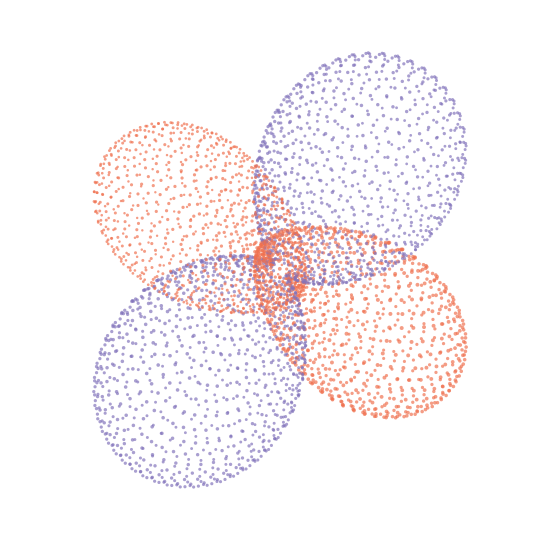
A calculation can leave behind a small collection of files: a structure here, an orbital grid there, a spectrum somewhere else. Keeping those pieces connected matters when you return to a result or hand it to someone else.
A container for the whole picture
QVF stands for Quantum Visualization Format. It is a ZIP-based archive designed to carry a calculation’s structure, scalar fields, spectra, bands, trajectories, wavefunctions, provenance, and viewer hints. Each archive includes the data its producer supplies; it does not have to contain every kind of result.
The format supports random access, so a consumer can read the pieces it needs. Typed payloads describe their data, and checksums help consumers verify the archive’s contents.
Shared across the ecosystem
QVF is the shared format for the vibe family. vibe-qc produces calculation archives, and vibe-view opens them for inspection. The format is also independent of the engine: other chemistry programs can produce QVF without installing vibe-qc.
The standalone QVF project maintains the specification and reference implementations. Its toolkit is Apache-2.0 licensed, making it usable by both open-source and proprietary programs. The aim is simple: let the result travel with its context.
Ready to go deeper?
Visit the developer hub